
Choosing denim solely by its colour can lead to surprises. Two fabrics that look similar can behave very differently when cut, sewn, worn or washed. One of the keys to anticipating that behaviour is knowing their weight per unit area. Fabric weight helps distinguish lightweight, flexible denim from thick, structured denim. However, it should not be considered in isolation: composition, stretch, finish, fabric density and the number of layers also affect the result.In this guide, you will learn how to interpret denim weights in ounces, relate them to grams per square metre and choose a suitable weight for garments, repairs, bags and upcycling projects. If you first need to review its structure and main varieties, read our guide to What denim is, its history, characteristics and types.
What Is Fabric Weight?
Fabric weight indicates how much a given area of fabric weighs. In the metric system, it is usually expressed in grams per square metre, abbreviated as g/m² or gsm. In the denim world, weight is very often expressed in ounces per square yard, oz/yd², although many commercial labels simply show “oz”.
This figure does not represent the total weight of the trousers or the exact thickness measured with a ruler. It describes the mass of a specific area of fabric and makes it possible to compare materials more consistently.
In general terms, a low value usually corresponds to a lighter, more flexible fabric, while a high value usually indicates more body and structure. Even so, two fabrics of a similar weight may feel different because of their composition, construction or finish.
Ounces and Grams per Square Metre
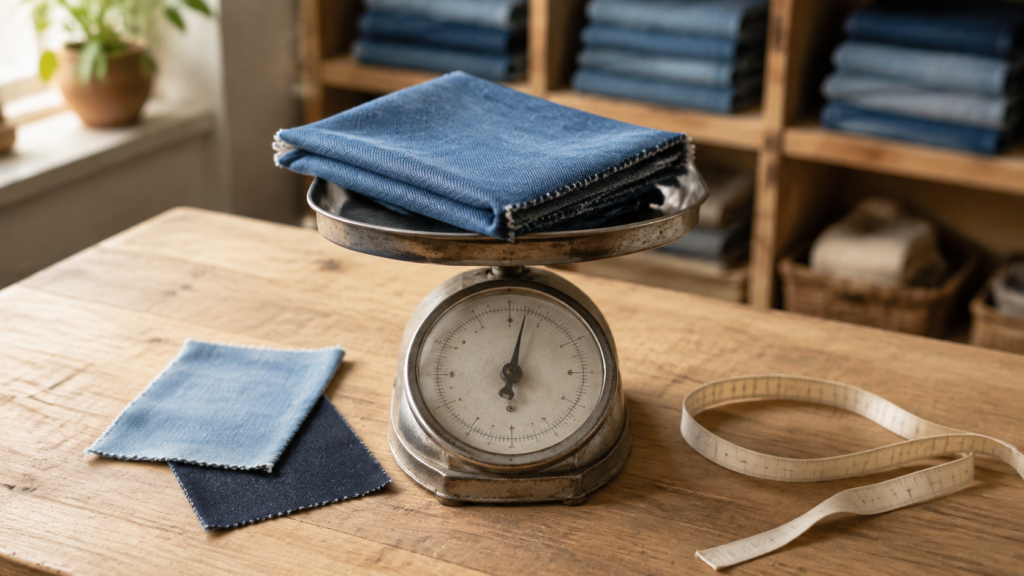
One ounce per square yard is approximately equal to 33.9 g/m². These reference values will help you find your bearings:
| Weight in ounces | Approximate equivalent |
|---|---|
| 5 oz | 170 g/m² |
| 8 oz | 271 g/m² |
| 10 oz | 339 g/m² |
| 12 oz | 407 g/m² |
| 14 oz | 475 g/m² |
| 16 oz | 542 g/m² |
The figures are rounded. If you are buying fabric, always use the information provided by the supplier and request a sample when the project requires a specific drape, stiffness or stretch.
A Practical Classification of Denim Weight
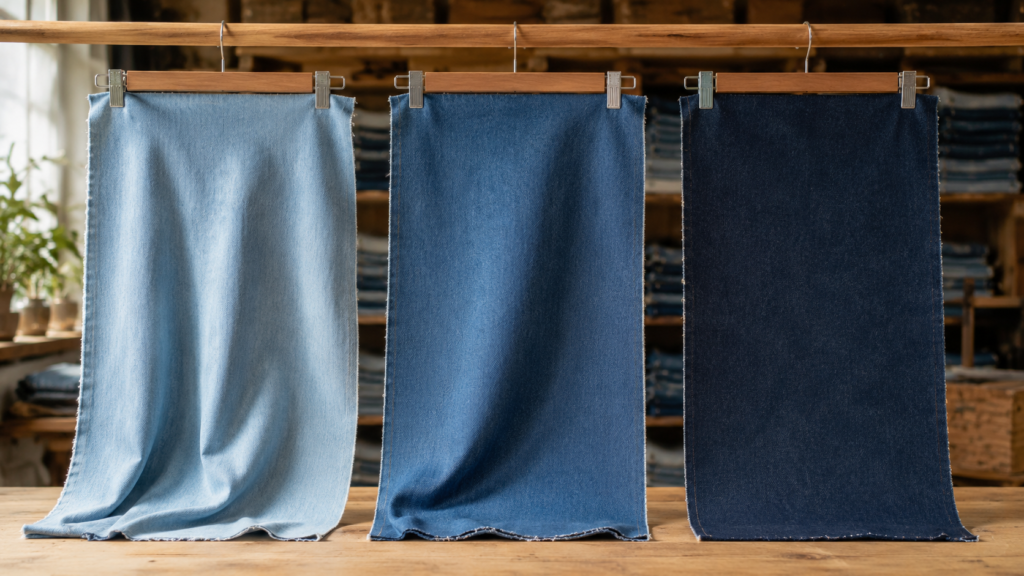
There is no single commercial classification used by every brand. The following ranges are practical guidelines, not rigid standards.
Lightweight Denim: Less Than 8 oz
It is usually more flexible, easier to gather and comfortable for garments designed to move. It may work well for:
- Shirts.
- Blouses.
- Dresses.
- Lightweight skirts.
- Hard-wearing linings.
- Accessories requiring little structure.
Some lightweight fabrics fray or distort easily, especially if they contain elastane. It is advisable to run tests before cutting the final piece.
Midweight Denim: Approximately 8 to 12 oz
This is a versatile range. It can provide enough body for garments while remaining manageable on many domestic sewing machines, provided that too many layers do not build up.
It is frequently used for:
- Trousers.
- Skirts.
- Structured dresses.
- Lightweight jackets.
- Reinforced bags.
- Intermediate upcycling projects.
Mid-heavyweight Denim: Approximately 12 to 14 oz
It has more body and may hold its shape better. It is common in classic jeans, jackets and hard-wearing accessories.
It may be suitable for:
- Structured trousers.
- Jackets.
- Bags.
- Work aprons.
- Organisers.
- Reinforcements and repairs.
Intersecting seams can create a substantial build-up of layers. Reduce bulk where the pattern allows and test the machine before you begin.
Heavyweight Denim: More Than 14 oz
It is thick, firm and demanding to sew. It can work for projects that require structure, but it is not always the best choice for a domestic sewing machine or for small pieces with many seams.
Before using it, check:
- The machine’s actual capabilities.
- The combined thickness at hems and intersections.
- The needle recommended by the manufacturer.
- The appropriate stitch length.
- Whether the project needs that much stiffness.
Do not force the handwheel or pull the fabric to help it feed through. If the machine cannot sew through the layers safely, change the construction or use suitable equipment.
Which Weight to Choose for Each Project
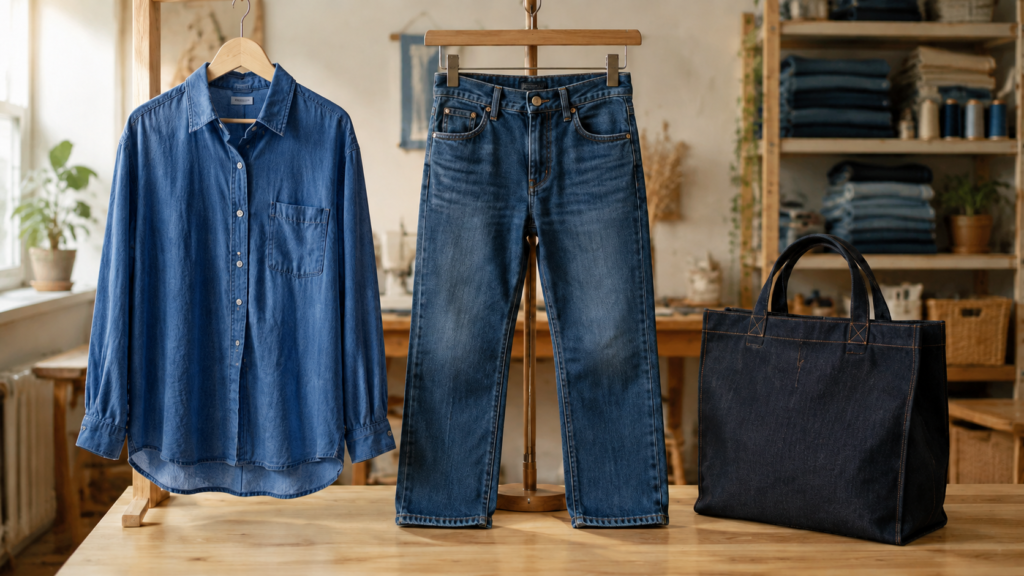
| Project | Weight guideline | What to check |
|---|---|---|
| Shirts and blouses | Lightweight | Drape, feel and transparency |
| Flowing dresses and skirts | Lightweight or light-midweight | Movement and stretch |
| Jeans | Midweight or mid-heavyweight | Composition, recovery and comfort |
| Jackets | Midweight or mid-heavyweight | Structure and seam bulk |
| Bags | Mid-heavyweight or heavyweight | Lining, interfacing and number of layers |
| Wash bags and cases | Midweight | Zip, lining and thickness at the corners |
| Cushions | Midweight | Flexibility and resistance to use |
| Organisers | Midweight or mid-heavyweight | Weight of the items they will hold |
| Repair patches | Similar to the original fabric | Stretch, thickness and grain direction |
| Patchwork | Compatible weights | Consistent behaviour across the pieces |
These guidelines are no substitute for testing the actual fabric. A lightweight denim bag can gain structure from interfacing and lining, while one made from heavyweight denim may become too stiff where seams build up.
Weight Alone Does Not Determine Quality
A high number does not automatically mean a better fabric. Quality and suitability also depend on:
- Fibre composition.
- Evenness of the weave.
- Thread strength.
- Warp and weft density.
- Colourfastness.
- Finishes and washes.
- Recovery after stretching.
- The intended purpose of the project.
A well-constructed lightweight denim may be perfect for a shirt, while a very heavy fabric may be uncomfortable and unnecessary. The best option is the one that meets the specific needs of the piece.
How Composition Affects Performance
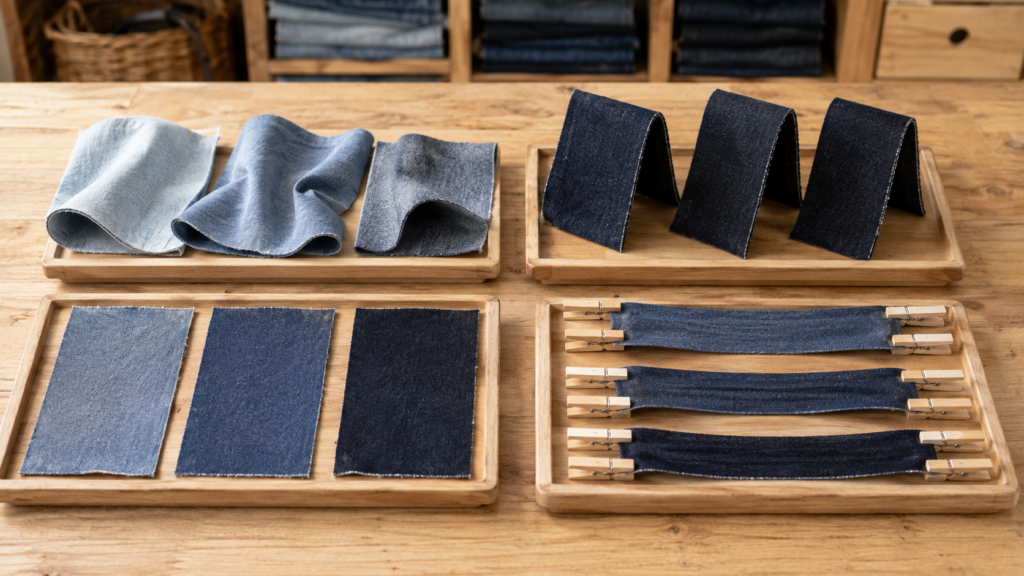
Cotton gives denim its traditional characteristics, but many fabrics include other fibres.
Denim with Elastane
Stretch can improve comfort, but it also affects stability. Stretch denim may require:
- Less tension during cutting.
- Stabilisation in certain areas.
- Stitches compatible with some stretch.
- Greater care when combining it with rigid fabrics.
Weight alone does not indicate how much it stretches or how well it recovers its shape. Always check the composition and test the fabric in both directions.
Denim with Polyester or Other Fibres
Blends can alter strength, drying time, feel and thermal performance. You should not choose them solely by weight. Read the label and adapt the iron, needle and thread to the actual composition.
Denim with Recycled Fibres
Its performance depends on the percentage and type of recovered fibre. The term “recycled” alone does not indicate strength, stretch or weight. Consult the manufacturer’s specifications and carry out tests.
How to Assess the Weight of Reused Jeans
When you work with a used garment, its label may not state the fabric weight. In that case, you do not need to know the exact figure to make good decisions.
Look at:
- Drape: hold up a panel and check whether it hangs easily or retains a rigid shape.
- Light: hold the fabric up to the light to identify thin or weakened areas.
- Stretch: gently stretch it horizontally and vertically.
- Recovery: check whether it returns to its shape or remains wavy.
- Bulk: fold several layers to anticipate the thickness of the seams.
- Wear: compare the knees, crotch and hems with protected areas such as the inside of the pockets.
Yousyslow tip: Keep a scrap from each garment and use it to test the needle, thread, tension and stitch length before sewing the main piece.
How to Measure Fabric Weight at Home
If you have sufficiently accurate scales and can cut a sample of known dimensions, you can estimate its weight using this formula:
weight in g/m² = weight of the sample in grams ÷ area of the sample in m²
Accuracy will depend on the sample size, scales, cut and condition of the fabric. A small sample magnifies errors. For technical or commercial work, a standardised method and controlled conditions must be used; a home estimate is intended primarily as a guide.
Do not cut up a valuable garment solely to obtain this figure. For a reuse project, it is usually more helpful to assess drape, stretch, strength and seam bulk.
Denim Weight and Jeans Repair
When carrying out a repair, do not choose a patch by colour alone. Its weight and stretch should also be compatible with the original area.
A patch that is too thick can create a rigid edge where stress becomes concentrated. One that is too lightweight may not provide enough support. If the trousers stretch but the patch is completely rigid, the two materials may move differently.
Before repairing:
- Remove loose threads without unnecessarily enlarging the damage.
- Check how much of the surrounding fabric remains strong.
- Choose a reinforcement that moves with the garment.
- Round off the patch corners if the technique allows.
- Test the stitching on a similar scrap.
Denim Weight and Upcycling Projects
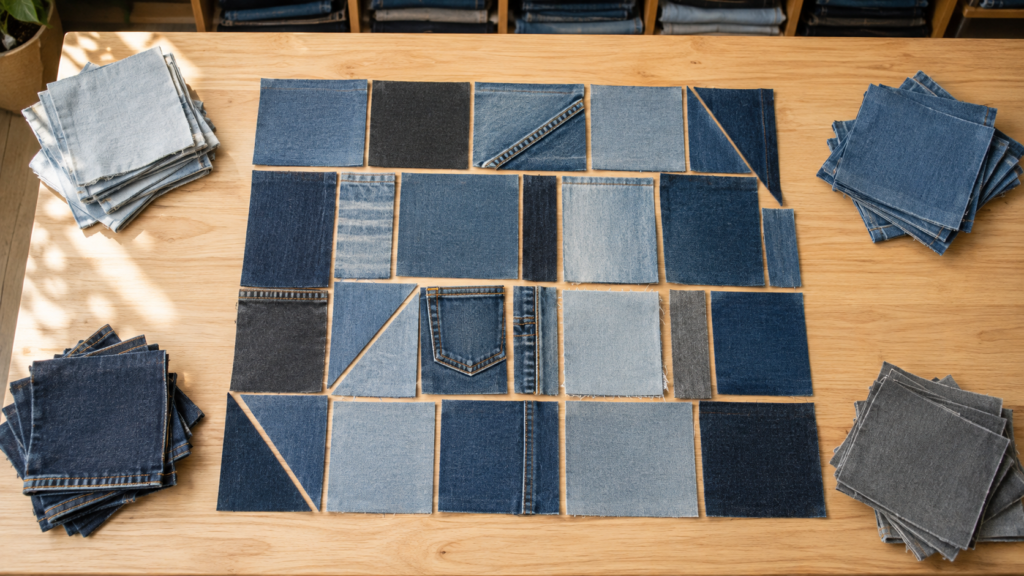
When reusing several pairs of jeans in the same piece, sort the panels by how they behave, not just by shade.
Group together:
- Rigid denim with rigid denim.
- Fabrics of a similar weight.
- Pieces with similar stretch.
- Worn areas that need stabilising.
In patchwork, extreme differences can cause rippling or create seams that are difficult to press. You can use interfacing to balance some pieces, but you should always test how the combination behaves.
If you would like to learn how to separate and sort every part of a garment, read the article Ideas for Reusing Old Jeans: Make the Most of Every Piece.
Common Mistakes When Choosing Denim by Weight
Assuming That Heavier Always Means Stronger
Strength depends on the fibre, construction, wear and quality of the fabric, not solely on the ounces.
Ignoring the Number of Layers
A fabric that is manageable as a single layer can become a problem at hems, zips, pockets or seam intersections.
Choosing the Weight without Considering Drape
Two fabrics with the same weight may differ in stiffness and movement.
Failing to Check the Stretch
A garment’s comfort and stability depend on its recovery as much as on its weight.
Skipping the Sewing Test
A sample allows you to adjust the needle, thread, stitch and tension without damaging the final piece.
Frequently Asked Questions about Denim Weight
How Many Ounces Are Typical Jeans?
There is no single figure. Many pairs of trousers are made from midweight or mid-heavyweight denim, but the choice varies according to the design, composition, season and manufacturer.
Is 12 oz Denim Thick?
It is usually considered mid-heavyweight and can provide plenty of structure. How it actually feels will depend on the composition, finish and fabric density.
What Fabric Weight Is Best for a Bag?
A midweight or mid-heavyweight fabric is often versatile. The final structure will also depend on the lining, interfacing, size and number of layers. A very heavyweight denim can create too much bulk at the seams.
Which Weight Is Best When You Are Starting to Sew Denim?
A midweight denim with little stretch and few layers is usually easier to practise with than a very heavyweight one. Always check your machine’s capabilities and use scraps for testing.
Can I Combine Denim of Different Weights?
Yes, but you should anticipate how they will behave together. Large differences in weight or stretch may require stabilisation and a specific construction method.
Does Fabric Weight Change after Washing?
Washing can alter dimensions, feel and apparent density, especially if the fabric shrinks. Follow the supplier’s instructions and prewash when the project requires it.
Conclusion
Understanding denim weight helps you anticipate its drape, structure and how difficult it will be to sew, but the number of ounces does not tell the whole story. Composition, stretch, finish, the condition of the fabric and the number of layers are equally important.
Before choosing, feel the fabric, fold it, check its recovery and carry out a sewing test. For reuse projects, also look at the actual wear in each area. Choosing according to performance rather than appearance alone allows you to create pieces that are more comfortable, hard-wearing and suited to their purpose.
What type of project would you like to make, and what denim weight are you considering? You can leave your question in the comments.